Sunday, August 19, 2007

The Collectors - Debut album - 1968


Originally formed in 1964 as the Classics (adopting the name CFUN Classics when they gigged to promote local Vancouver, BC radio station CFUN-AM), the group was featured as the house band on Let's Go, a weekly TV show. In 1965, they released two singles as the Canadian Classics and then reinvented themselves as the Collectors in 1966. By 1967, in addition to lead singer Howie Vickers, the Collectors included Claire Lawrence (tenor sax, organ, recorder, flute), Bill Henderson (lead guitar), Glenn Miller (bass) and Ross Turney (drums) -- the band's "classic" line-up. Recordings from this period include their stunning debut LP titled “The Collectors” and followed with “Grass and Wild Strawberries.” Vickers' departure from the Collectors in 1969 necessitated Henderson's promotion to lead vocalist. Eventually, the band rechristened themselves Chilliwack.
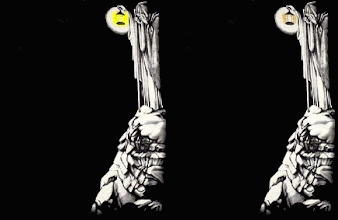
Behind the superb Art Nouveau artwork on the sleeve of this their self titled debut (1968) is hiding one of the true, hidden and forgotten gems of Canada. To achieve this kind of perfection as a first try, back in the late 60’s is simply astounding (they only had a few singles beforehand) and unfortunately all too rare. Bill Henderson and Claire Lawrence (the main core of the group) made a fantastic songwriting partnership.When you put together a group of top-notch classically-trained, jazz and rock musicians, the result is likely to be extraordinary - and this album is unique. Every song on the A side is different, ranging from bouncy Tull-like folk-rock through acid/metal to a pessimistic anemia sounding like Jim Morrison on downers. The album was more a local and cult favourite than a major success; the only top-40 single was Lydia Purple (a bit like Eleanor Rigby with recorder obbligato) - and ironically the only song not written by the Collectors themselves. Side B is a single continuous piece on the theme "What is Love", innovative and remarkably successful, running the gamut from moody reflection through psychedelica to frenzied despair for almost 20 minutes
I first spotted this as an LP back when it was released some thirty-eight years ago. A friend had a copy and the cover intrigued me so I checked it out. It proved to be more than intriguing so I hunted down a scratchy copy of my own at a local thrift store and later replaced it with a by-then rare and expensive near mint LP. It has always been a favorite of mine. Yes side 2 (the last cut on the lp) is taken up by the indulgent "What Love (Suite)", however side one is a treasure from the opening ethereal to anthemic "What Is Love" to the brilliant psychedelic/pop of "She (Will-O-the-Wind)" and "Lydia Purple", filled with an abundance of tasty hooks and folk-rock harmonies that remind one of the equally esoteric finer moments of The Electric Prunes and Giles & Fripp. These two songs alone are worth the price of this album. Why they didn't cross over and become hits in North America is beyond me, but so goes the music industry. And then there's Howard Vicker's crooning on "One Act Play", which is powerful and yearning, so much so as to make Scott Walker envious. There's even the sci-fi rock ballad "Howard Christman's Older", which joins the ranks of great, little known gems along side Clearlight's "Mr. Blue", the latter certainly not to be confused with the Fleetwoods classic of the same name. I have played this LP to a number of friends over the years, people with varied and eclectic tastes, and all of them have marveled at this record. You will too. I hope many more people discover the unique flavour of this short-lived Canadian West-coast phenomenon. Need I say more?? Actually, yes!!! The record company says "New Vibrations From Canada" on the back sleeve, but when some almost 30 years later, you listen to this record, WOW!!! They are still brand new vibrations.
1 What Is Love (3:53)
2 She (Will-O-the-Wind) (3:53)
3 Howard Christman's Older (5:10)
4 Lyndia Purple (2:48)
5 One Act Play (3:43)
6 What Love (Suite) (19:05)

Saturday, August 18, 2007

#1 Record / Radio City - Big Star


The merits of Big Star can hardly be overstated due to the band's lasting influence on soooo many artists - an ABRIDGED list might include Tom Petty, Cheap Trick, Replacements, R.E.M., Game Theory, Bangles, Teenage Fanclub, and Jimmy Eat World. Of course, with most of these bands becoming MUCH more well known than Big Star, the influence is diminished somewhat because the original is heard AFTER the followers. Regardless, Big Star's 1st 2 albums create an essential release made even sweeter by the 2-for-1 deal encapsulated here and the tunes still sound fresh listen after listen. Along with Badfinger, Big Star is the absolute touchstone for melancholy pop songs that should have been huge hits - forming the basis for every power pop pretender to the throne. Like almost everyone, I didn't hear of Big Star until long after their demise. In fact, I didn't hear the group until I had heard some of Alex Chilton's solo records, around about 1986. If you started out, as I did, knowing that Chilton was the singer at the helm of pop/soul hit machine The Box Tops, you cannot have been prepared for these two albums steeped in Zombies, the more melodic aspects of The (original) Small Faces and perhaps another obscure delight, Honeybus. This music is so unexpected for anything from Memphis, that it was probably buried for that reason alone.Since other folks seem to be more readily drawn to the first album with Chris Bell's pleasing work, I'll champion the edgy brilliance of Chilton's accomplishment with "Radio City." First off, there is the lengthy almost stream-of-consciousness rock n roll of "O My Soul." This performance is a fantastic showcase of Chilton's prowess on guitar and a very cool one-song lesson in how to take formerly familiar mid-60s British melodic hard rock and make it new simply by throwing it up in the air and playing it in the order that it falls back down. The entirety of "Radio City" has a great sloppy feel applied to straight-out terrific rock/pop songs. It is this odd sloppy/classic juxtaposition that so many groups have since imitated. This is no accident; the first album proves that the band could turn out perfectly polished gems if they were so inclined. Chilton must have had incredible self-confidence to release a record like this in 1973, the era of over-blown multitrack productions from the mainstream groups.Do you love the sound of classic rock guitar, both acoustic and electric? Then treat yourself to this fine release. It really doesn't get better.

Friday, August 17, 2007

Colours 1968


One of the best American psyche albums we've heard from the late 60s -- a near-perfect record that's head and shoulders above the rough experimentation of most other groups from the period! Colours spell their name with a definite British twist, and there's clearly a Beatles influence going on here -- a sound that's almost pre-Sgt Peppers, but which has wonderfully complicated time changes, vocal parts, and production techniques that must have cost a pretty penny to such a little-known group! Horns and strings are arranged by Dave Roberts, and handled with a sensitivity that almost matches The Zombies' best at times -- and the tunes themselves are a fresh variety of odd themes, including one number about robbing a liquor store. Titles include "Brother Lou's Love Colony", "Bad Day At Black Rock Baby", "Love Heals", "Rather Be Me", "I'm Leaving", "Cataleptic", "Don't You Realize", and "Lovin".
Colours were a west coast psychedelic pop act that came together in 1967 at the request of songwriters, Jack Dalton and Gary Montgomery. Essentially a studio project, Colours featured future Derek and the Dominoes bassist, Carl Radle, who had already made quite a name for himself as a session musician and touring performer. The album was assembled over several months in late 1967, and subsequently issued by Dot Records the following year. Dot, being primarily an easy listening and country label, had little experience dealing with a band like Colours and thusly the album failed to explode as a result of their poor marketing. Quickly, the album became a collector's item and its value has only increased over the years.

Much like the Lemon Pipers or Grapefruit did, Colours attempted to sustain themselves autonomously after their partnership with Dalton and Montgomery had expired. Releasing their followup, "Atmosphere" in 1969, the album was a glaringly inferior effort, eschewing much of the sunny pop leanings of the debut.
The album came and went with little fanfare and members began defecting to other musical opportunities. Colours ceased to exist in 1970. Members went on to work with Taj Mahal, Derek and the Dominoes, Eric Clapton, JJ Cale, Joe Cocker and Freddie King. Radle passed away in 1980 from a lethal combination of alcohol and narcotics. To call this an unsung gem is an understatement. "Colours" is a brilliant Beatlesque masterpiece that, while somewhat derivative, is rife with bouyant arrangements, strong melodic hooks and sophisticated soundscapes. From beginning to end, the album is tight and focused. Like a cross between Left Banke, The Beatles and Orange Bicycle, the band's slight psych temperment is perfectly balanced with their impeccable musicianship and pitch perfect harmonies. One listen to the opener, "Bad Day at Black Rock, Baby" and their mission is crystal clear. The band never relents and at its conclusion, "Colours" leaves you wanting more. Sadly, there wasn't much more left, but damn if this isn't satisfying. Though the album has been bootlegged in Korea on CD, this has never officially been reissued. While we wait (don't hold your breath), check out this clean vinyl rip and marvel...this is great stuff!

Bandit (USA) - 1975


Not to be confused with Australia's Bandit, this act sprang from the Pacific Northwest in late 1974 and featured Joey Newman on guitar and keyboards. Newman was quite a
figure on the scene, having been a member of Don & the Good Times, Blue Mountain Eagle, Touch and the infamous, Stepson. Bringing his own experience to the fold was drummer Dan Gorman, who had previously played with Los Angeles superstars, The Yellow Payges.
Rounding out the lineup were guitarist Davis Della Rosa, bassist Kevin Barnhill and vocalist Tommy Eaton. It's safe to assume that Newman's association with ABC Records during sessions for Stepson's sole release, is at least partly responsible for the formation of Bandit and their self-titled debut, which they issued in 1975.

Taking cues from Stepson, as well as other heavy soul influenced acts like Crow and Mother's Finest, the band's sound was a bit out of sync with much of what was popular in the mid 70's and ultimately this direction was their undoing. The band began imploding at the end of a short tour supporting numerous larger acts and by 1976, ABC chose to drop the band, signalling their death the same year. Little is known about the subsequent activities of the members, though Newman did work with the Osmonds and Shaun Cassidy in later years.

"Bandit" is an incredible slab of soul driven hard rock that effortlessly shifts from grit to subtlety. At times, the band goes straight for the Motown sound with total abandon, while at other times they can be heard at full steam, complete with Eddie Hazel inspired guitars and a smoking rhythm section. Eaton's smoldering vocals morph from Gaye smoothness to Cocker bravado all in the span of a single track. The soulful female backup singers provide the proverbial icing on the cake. Reminds me a lot of the early Doobie Brothers sound but with much more bravado and excitement. There's very little not to absolutely love about this well assembled album. Simply awesome. Need proof? Check out this flawless vinyl transfer and get the goods while they're hot...at 320 kbps! (Thanks to Ronnie aka J and mamedia)

Thursday, August 16, 2007

Today - The Beach Boys - stereo!


A precursor to the landmark Pet Sounds album, this album has criminally never been entirely issued in full dimensional stereo - until now! Used to be packaged in a mono twofer series with bonus tracks, expanded liner notes, etc, then reduced to a basic CD with no bonuses whatsoever, then deleted entirely. This music shows Brian Wilson's growing talent and mastery in the studio as his songs became less focused on the Southern California lifestyle and more introspective.
"Today"showcases Brian Wilson's rapidly expanding talents in the heady days just before the release of the landmark LP, Pet Sounds. The arrangements are lush and brilliant and many of the themes that were to find full expression in Pet Sounds were already forming here.
This is an extremely mature album from one of the greatest bands in the history of rock music. It's astonishing that it's never been issued in stereo.

Track Title
1. Do You Wanna Dance?
2. Good To My Baby
3. Don't Hurt My Little Sister
4. When I Grow Up
5. Help Me, Ronda
6. Dance, Dance, Dance
7. Please Let Me Wonder
8. I'm So Young
9. Kiss Me, Baby
10. She Knows Me Too Well
11. In The Back Of My Mind
12. Bull Session With The "Big Daddy"

New England - Self Titled debut - 1979


"This quartet formed around Boston under the auspice of powerhouse manager Bill Aucoin, who ruled the '70s with Kiss. Guitarist and vocalist John Fannon proved to be the guiding light of the band, with Jimmy Waldo providing impressive keyboards and Gary Shea on bass while Hirsh Gardener worked the drums. Paul Stanley came over from the Kiss camp to produce New England's sterling debut (featuring the incomparable "P.U.N.K." and the incredible "Nothing to Fear"), an orchestrated, absorbing affair with the boys giving all. The lush "Don't Ever Wanna Lose Ya" nicked the Top 40 and proved to be New England's moment in the sun. Despite an opening stint supporting the falling but still high-profile Kiss, New England unfortunately slid between the cracks with Starz and Piper, two other talented Aucoin projects. The similar sophomore effort, Explorer Suite, garnered almost no notice, and Todd Rundgren's production on the innovative Walking Wild also didn't produce sales. New England dissolved, with Shea and Waldo ending up in Alcatrazz." --- AMG

"Produced by Paul Stanley of Kiss who was also represented by manager Bill Aucoin, this Boston band's debut still stands as their finest. "Hello, Hello, Hello," much like Alice Cooper's use of Rolf Kemp's "Hello Hooray," is a nice opener, but the lyrics are more like Stevie Nicks witchcraft and magic. Song two is the most classic statement made by writer John Fannon and his group New England. "Don't Ever Wanna Lose Ya" is perhaps the shortest poem/song on record by Fannon, but it is his most famous. There are swirling keyboards by Jimmy Waldo and the precision the band is known for in performance. Like another Boston-based group, Private Lightning on A&M with their local hit "Physical Speed," these groups were ahead of their time and exploring sounds that were not identified with the city that brought the world the Modern Lovers, Aerosmith, and the Jonzun Crew. But with three albums on a major label, and superb production, New England had a good shot at the brass ring and a tune with all the elements of "hit" in this track. "P.U.N.K." is also a song that generated attention. About a punk, and certainly not punk rock, although the band frequented (and played) the clubs like the Paradise and the Rat, which, no doubt, helped inspire this. "Shall I Run Away" has a great vocal from Fannon and is the best tune next to "Don't Ever Wanna Lose Ya" -- mellow with cosmic guitars, a unique sound removed from the Asia style producer Mike Stone and the band New England became known for, almost Roxy Music. And that is where the band could've really made its mark, by being more experimental and less like the arena rock bands of the day. "Alone Tonight" is a great song held back by the "overproduction," to quote the late Stones producer Jimmy Miller and his idea of the New England sound. The thick production on this music is incessant. "Nothing to Fear" has hooks a plenty and the voice more prominent; "Shoot" is like a progressive Black Sabbath riff sped up and gone pop. Fannons' great ideas and lyrics seem to get lost in some of the instrumentation of "Turn Out the Light." That stage life which Paul Stanley knows so well from the Kiss hit "Beth" is the theme of "The Last Show." "Encore" concludes the album with Fannon almost sounding like Roger Waters in delivery and idea. New England deserves recognition for years of hard work and the creation of a very important tune from the late '70s. The cover photo has Terminator-style lightning (so did Private Lightning's cover, of course) and the band being delivered from out the blue." --AMG

One of my fave records of all time. I was 16 when the hit "Dont Ever Wanna Lose Ya" hit the airwaves and just on the cusp of high school graduation. I thought I would share this one with those of you that might remember it , & yet have forgotten how good these guys were. This came from a pristine vinyl source declicked and denoised for optimum beauty. For fans of Journey , Boston , April Wine , Cheap Trick , etc.

New England - s/t debut - 1979 - Infinity - MCA records --
MP3 @ 256 - VBR

1- Hello, Hello, Hello
2 - Don't Ever Wanna Lose Ya
3 - P.U.N.K. (Puny Undernourished Kid)
4 - Shall I Run Away
5 - Alone Tonight
6 - Nothing to Fear
7 - Shoot
8 - Turn Out the Light
9 - The Last Show
10 - Encore

Tuesday, August 7, 2007

Hammersmith - Hammersmith 1975


Wow! This is one I have been looking for forever. These guys actually played live at one of my Grade 10 BDCHS school dances back in the day. They rocked then and continue to do so now. Hammersmith rose from the ashes of Canadian rockers, Painter, in late 1974. With principals Doran Beattie and Dan Lowe in the fold, the band's name power helped them to land a deal with Mercury Records and "Hammersmith" was issued in 1975. The band set out on a tour of Canada and through a number of high profile shows and moderately successful singles, the band were granted a healthy budget increase for their followup. That came in 1976 with "It's For You". Though the sound and production was noticeably slicker, the material was weaker and the album failed to ignite Canadian radio. As a result, the band (with a newly revamped lineup) began falling apart at the seams, prompting a full blown split in 1977. Beattie later turned up as a country solo artist, while other members went on to 451° and Moxy.
"Hammersmith" takes cues from The Guess Who in places, which is understandable considering their reverence in their homeland. The album is fairly consistent, with the band keeping a nice balance of hard and soft throughout. The guitar work is stellar and the harmonies are tight, particularly on album highlight "Feelin' Better". This album has earned quite a cult following over the years, but sadly has never been issued on CD. And now for your listening pleasure check out some cool Canadian rock...

Thursday, August 2, 2007

The Creme of The Hot Stuff - The Rolling Stones


MP3 320kbps
Artwork Included
TrackList
01 Gimme Shelter (different version with Keith on vocals)
02 Sympathy For The Devil (exquisite and rare Beggars Banquet outtake)
03 Brown Sugar (altered version with different Mick Taylor lead-guitar)
04 Shake Your Hips (Rehearsal Montreaux 1972)
05 Jive Sister Fanny (late 1969 acetate with Mick Taylor on guitar)
06 I'm Going Down #1 (lost Stones classic,1969 acetate with Mick Taylor on guitar)
07 Everything's Turning To Gold (Some Girls outtake)
08 I Go Wild (extended, complete and different version)
09 The Storm (Love Is Strong B-side, different mix)
10 Memo From Turner (early version in a voodoo mood)
11 Let's Go Steady (Emotional Rescue outtake)
12 I'm Going Down #2 (live 1991 with Keith & Bob Dylan on vocals)
13 Paint It, Black (live Hawaii 1966)
14 (I Can't Get No) Satisfaction (live Hawaii 1966)
15 Not Fade Away (Pollwinners concert NME)
16 I Can See It (Between The Buttons outtake)
17 Out Of Time (different outtake-version 3/66)
18 The Last Time (Outtake version 1964)
* 19 You Can't Always Get What You Want (alternate studio-version 1971)
* 20 Angie (different Promo-version 1973)
* Special Bonus Tracks
Password: stonestocry.blogspot.com

Hudson Brothers - Ba Fa - 1975


Ba-Fa was the band's fourth album and the last truly worthy entry in their repertoire. Bearing shades of the Beach Boys and Beatles, the material does sometimes tend to come across schizophrenic. In spite of its identity crisis, "Ba-Fa" is generally regarded as one of the band's classic recordings. If you've never heard the album, then enjoy this clean vinyl transfer. Check it!

Hudson Brothers - Hollywood Situation - 1974


As promised, their 3rd LP "Hollywood Situation" from Casablanca Records in 1974. Having established some success on television, the band works in songs culled from their variety show as well as a pointless Chucky Margolis skit. The material is mostly strong, though there appears to be a lack of focus here. Nonetheless, fans should eat this one up. Enjoy! Ripped from the original vinyl and tweaked for excellent sound repro.

Wednesday, August 1, 2007

Totally Out of Control - The Hudson Brothers


If ever there ever was a band who personified both teenage idol fluff AND true artistic merit, it is the Hudson Brothers. Long before David Cassidy, Leif Garrett, Bay City Rollers and other teen icons sprang upon the scene, the Hudsons were hard at work in the pacific northwest under the name, The New Yorkers. Several years on the scene finally landed them a label deal with Playboy Records and a name change. Their self-titled debut, "Hudson", was issued in 1972 but sales were slow and the album vanished quickly. Luckily, their new friend Elton John signed them to his Rocket Records label and Hudson mania quickly set in.
This album, entitled "Totally Out of Control", was their first under the direction of Elton John and partner Bernie Taupin. It's a brilliant power pop album oozing with hook filled melodies, soaring harmonies and loads of conviction. Another album and hit single later, they were bona fide rock stars. In 1974, Hudson mania reached its peak and the boys became the hosts of their own variety show, "The Hudson Brothers Razzle Dazzle Show". Gracing the covers of practically every teen magazine during this time period ensured their celebrity, but also stripped them of the respectability they eagerly sought.
Despite that they had 'sold out', their music was as solid as ever and there was no denying their writing and performing talents. Sadly, as with most 70's teen icons, their fame was brief and by 1977, the backslide into banality had begun. Two albums followed and by the early 80's, they were all but forgotten. Luckily, each of them have gracefully transitioned into other areas of showbiz and have maintained successful careers ever since. Mark, the mustachioed middle brother has toured in Ringo Starr's All-Stars Band for years and has written huge singles for Hanson, Aerosmith and Celine Dion. Brett and Bill have moved into film and television production.
Apart from a late 90's retrospective release, the Hudsons have never seen CD reissue. This classic album, along with "Hollywood Situation" and "Ba-Fa" have been circulating in file trading circles for a few years now. This trifecta of golden power pop will be featured here in the coming days, beginning now with "Totally Out of Control". Download this clean vinyl rip and enjoy the goodness of the Hudson Brothers!

http://www.megaupload.com/?d=EDHTN4ZE

Sparks - Introducing...

How can you accurately summarize a band like Sparks? Just when we thought they were an avant garde act they changed gears and became a new wave band instead. Years later they'd evolve into an electronica group and remain so for over a decade. Now it seems the Mael brothers are exploring new territories as their last two albums experiment with choral and orchestral themes. Somewhere in their evolution this bastard child known as "Introducing..." popped out...well, in 1977 to be precise. Most Sparks fans don't regard this as a masterwork simply because this is an album that plays it safe. Pop arrangements, session players running amok and even Russell's voice seems tempered. Now, that isn't to say this is a bad album. It's chock full of hooks and Ron's clever wordplay.
So what warrants its inclusion here? Well, this is the only Sparks album to have never been given the digital treatment. Columbia Records has ignored the fans and so it languishes in the vaults. In the interim, while Columbia figures out what to do with this record, take a listen and enjoy this often ignored piece of Sparks history. If it's Sparks, it definitely isn't bad.

http://www.megaupload.com/?d=RGR5TSJI

Genesis 3X3 ep - 1983


And now, an EP. This one has an interesting story that I'll share with you before heading out camping. Originally, this came out in the UK as an EP. The States got the tunes too, but they got 'em in the "Three Sides Live" compilation. As you might imagine, these studio tracks were on the fourth side (along with two extra tracks).The funny thing is, this was never released on CD in and of itself. The first time we saw them was on the original CD issue of "Three Sides Live." But when this set was remastered, the non-live tracks were omitted. Then, when the Genesis Archive #2 1976-1992 box set popped up, we got two out of three songs: "Paperlate" and "You Might Recall." The last song, "Me and Virgil," was missing in action.Later this month, we'll see the release of Genesis 1976-1982, a box set that collects all of the bands albums from that period (in addition to EPs and singles and b-sides), remixes and remasters them and places them in one expensive package.So, if you're willing to sacrifice a bit of sound quality for the sake of saving a few (hundreds of!) dollaroos, dig the original "3 x 3" EP:1. Paperlate2. You Might Recall3. Me and Virgil

The Yardbirds - Roger The Engineer - 1966


Once Jeff Beck joined the Yardbirds, the group began to explore uncharted territory, expanding their blues-rock into wild sonic permutations of psychedelia, Indian music, and avant-garde white noise. Each subsequent single displayed a new direction, one that expanded on the ideas of the previous single, so it would seem that Roger the Engineer -- Beck's first full album with the group and the band's first album of all-original material -- would have offered them the opportunity to fully explore their adventurous inclinations. Despite a handful of brilliant moments, Roger the Engineer falls short of expectations, partially because the band is reluctant to leave their blues roots behind and partially because they simply can't write a consistent set of songs. At their best on Roger, the Yardbirds strike a kinetic balance of blues-rock form and explosive psychedelia ("Lost Woman," "Over, Under Sideways, Down," "The Nazz Are Blue," "He's Always There," "Psycho Daisies"), but they can also bog down in silly Eastern drones (although "Happenings Ten Years Time Ago" is a classic piece of menacing psychedelia) or blues tradition ("Jeff's Boogie" is a pointless guitar workout that doesn't even showcase Beck at his most imaginative). The result is an unfocused record that careens between the great and the merely adequate, but the Yardbirds always had a problem with consistency -- none of their early albums had the impact of the singles, and Roger the Engineer suffers from the same problem. Nevertheless, it is the Yardbirds' best individual studio album, offering some of their very best psychedelia - one of their very best!
Also be sure to find a copy of Birdland (2003) their newest platter and a guitar tour de force!

Hammersmith - review


Good 70s hard rock LP, whose band roots are traced back to Calgary Alberta Canada. The core members, Danny Lowe-Lead Guitar, Doran Beattie-Vocals, are from a 60s psych band called 'The 49th Parallel, also from Calgary. With The 49th Parellel's demise, the band then evolved into 'Painter', who released one album of early 70s hard rock in the style of BTO or April Wine, and played just as well. From the ashes of 'Painter', 'Hammersmith' evolved, and followed the same heavy rock formula. The band went through a few personnel changes, and as people came and went, Mike Reno joined the band for a spell after leaving 'Scruballoe Caine', and prior to his days in 'Moxy' or 'Loverboy'. Hammersmith made two albums, then split up. This LP is the better of the two. In 1982, Danny Lowe experienced what he called "an industrial accident" while placing 14 microphones in a sound studio. In playing back the recording made that day, he discovered he had inadvertently created an auditory illusion that he was surrounded by sound. The effect resembled how the human ear actually hears. Over the next eight years, he and electro-technician John Lees worked together to fine-tune the system. In 1986, the pair formed a partnership with Larry Ryckman, a former Calgary real estate developer, and formed Archer Communications Inc. QSound was patented in 1990, and the recording system was quickly embraced by music artists such as Sting, Madonna, INXS, Pink Floyd, Kate Bush, Paula Abdul, Julian Lennon, Wilson Phillips and Luther Vandross. Doran Beattie went on to have somewhat of a succesful country music career! There's a quick history lesson on some good 'ol local boys!